Cross-Docking vs. Warehousing: Which One Is Right for You?
A practical guide to choosing the right fulfillment and distribution strategy
In modern supply chains, speed, flexibility, and cost efficiency have become critical factors in determining how successfully a business can serve its customers. As e-commerce continues to grow and customers expect faster delivery, businesses are increasingly evaluating how they handle inventory once it reaches a distribution facility.
Two common logistics strategies are cross-docking and traditional warehousing. While both play important roles in supply chain management, they serve very different purposes.
Cross-docking focuses on moving products quickly from inbound transportation to outbound transportation with little or no storage in between. Warehousing, on the other hand, involves receiving, storing, managing, picking, packing, and shipping inventory over a longer period.
So, which approach is right for your business?
The answer depends on your inventory characteristics, order patterns, customer expectations, transportation network, sales channels, and overall supply-chain strategy.
What Is Cross-Docking?
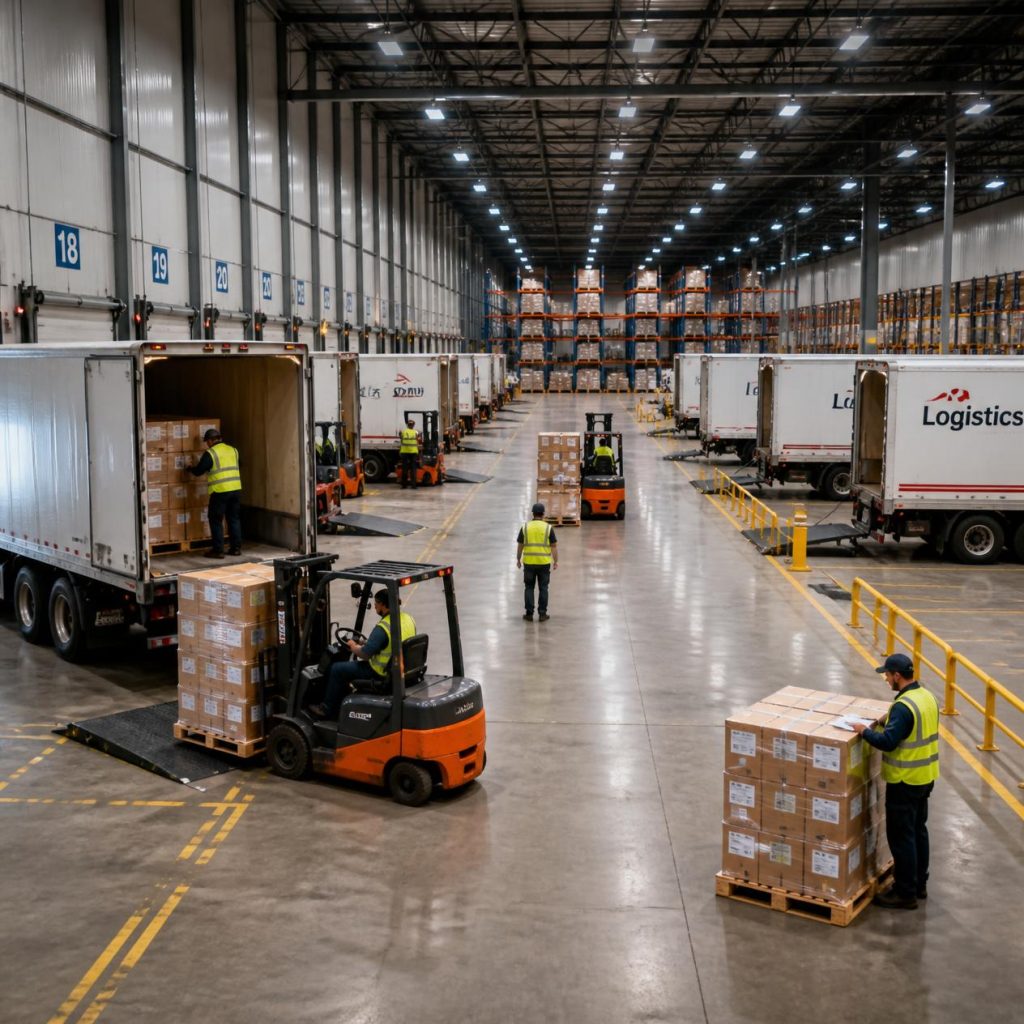
Cross-docking is a logistics process in which incoming products are received at a distribution facility and transferred directly to outbound transportation with minimal or no long-term storage.
Instead of putting products away into warehouse storage locations, the facility acts primarily as a transfer point.
A simplified cross-docking process looks like this:
Supplier → Inbound Transportation → Cross-Dock Facility → Outbound Transportation → Customer
For example, imagine a retailer receives 20 pallets of products from a manufacturer. Rather than storing those pallets for several weeks, the facility receives them, sorts or consolidates the products, and loads them onto outbound trucks destined for different retail locations.
The inventory may spend only a few hours—or potentially a day—at the facility.
The primary objective is movement rather than storage.
How Cross-Docking Works
A typical cross-docking operation includes:
- Advance shipment information — The supplier provides information about incoming products, including SKU, quantity, destination, and shipment details.
2. Inbound receiving — Products arrive at the facility, and workers verify quantities, packaging, labels, and shipment information.
3. Sorting and staging — Products are sorted based on destination, customer, store, or outbound shipment.
4. Consolidation — Products from multiple suppliers may be combined into a single outbound shipment.
5. Outbound loading — Products are moved to the appropriate dock door and loaded for departure.
6. Delivery — Products move toward stores, customers, fulfillment centers, or other distribution points.
The key characteristic is that inventory spends very little time sitting in storage.
What Is Traditional Warehousing?
Traditional warehousing involves holding inventory in a facility until it is needed.
The warehouse performs several activities, including receiving, inspection, putaway, inventory storage, inventory control, order picking, packing, labeling, value-added services, shipping, and returns processing.
A traditional fulfillment flow generally looks like:
Supplier → Inbound Transportation → Warehouse → Storage → Picking → Packing → Outbound Transportation → Customer
Unlike cross-docking, warehousing provides businesses with a buffer between supply and demand.
For example, a business may purchase 10,000 units from a manufacturer but sell only 500 units per week. Instead of receiving 500 units every week, the business can store the inventory and fulfill customer orders as they are received.
This is one of the fundamental advantages of warehousing.
Cross-Docking vs. Warehousing: The Key Difference
The simplest way to understand the difference is:
Cross-docking prioritizes speed and inventory movement, while warehousing prioritizes inventory availability and flexibility.
Benefits of Cross-Docking
- Faster Product Movement
Products can move from suppliers to customers or retail locations much faster. Minimizing storage and intermediate handling can shorten the time products spend inside the supply chain. - Lower Storage Requirements
Because products are not intended to remain in the facility for extended periods, businesses may require less traditional storage space. - Reduced Inventory Carrying Costs
Holding inventory comes with costs such as warehouse rent, utilities, labor, insurance, security, inventory management, shrinkage, and obsolescence. Cross-docking can reduce some expenses by minimizing storage time. - Faster Replenishment
Retailers and distributors can replenish stores or distribution points quickly. For businesses selling high-volume products with predictable demand, this can create a more responsive supply chain. - Lower Product Handling
Traditional warehousing may involve unload → putaway → storage → pick → stage → load. Cross-docking can potentially reduce this to unload → sort/stage → load, reducing handling time and opportunities for damage.
Types of Cross-Docking
- Pre-Distribution Cross-Docking
The final destination and customer requirements are known before products arrive. The facility receives and sorts products before shipping them to their destinations. - Post-Distribution Cross-Docking
Products arrive before the final destination is fully determined. The facility may temporarily hold or stage inventory until customer demand or destination information becomes available. - Continuous Cross-Docking
Products move through the facility almost continuously. Inbound shipments are closely synchronized with outbound shipments. - Consolidation Cross-Docking
Multiple smaller inbound shipments are combined into larger outbound shipments. - Deconsolidation Cross-Docking
A large inbound shipment is divided into smaller outbound shipments.
Benefits of Traditional Warehousing
- Inventory Buffer
Warehousing allows businesses to purchase or manufacture inventory before it is needed, creating a buffer against supplier delays, transportation disruptions, demand spikes, seasonal fluctuations, and manufacturing interruptions. - Better Support for Variable Demand
Warehousing provides flexibility when customer orders fluctuate significantly. - E-Commerce Fulfillment
Online orders typically require individual item picking, multi-item order assembly, packing, shipping label generation, carrier selection, tracking, and returns processing. - SKU Variety
Businesses selling hundreds or thousands of SKUs often need warehouse storage to organize inventory by SKU, category, size, velocity, customer, sales channel, lot, or expiration date. - Value-Added Services
Warehouses can perform kitting, bundling, repackaging, relabeling, quality inspection, product assembly, promotional inserts, custom packaging, subscription box assembly, and retail compliance labeling.
The Role of 3PL Providers
Third-party logistics providers, or 3PLs, can support businesses using warehousing, cross-docking, or a hybrid model.
A 3PL may provide warehousing, cross-docking, order fulfillment, inventory management, transportation coordination, freight management, kitting, pick and pack, returns management, FBA preparation, and retail distribution.
For businesses that do not want to invest heavily in warehouse infrastructure, outsourcing logistics to a 3PL can provide access to facilities, technology, labor, and transportation networks.
A business may also use the same 3PL for both cross-docking and traditional storage.
When Cross-Docking Makes Sense
Cross-docking is generally more suitable when several conditions exist:
- High-volume products
• Predictable demand
• Stable and reliable supply
• Short delivery windows
• Retail distribution requirements
• Perishable or time-sensitive goods
• Promotional inventory requiring rapid distribution
When Traditional Warehousing Makes More Sense
Traditional warehousing is generally more appropriate when:
- Demand is unpredictable
• Products have many SKUs
• Orders are highly customized
• Supplier lead times are long
• Products require value-added services
• The business sells through multiple channels such as Shopify, Amazon, Walmart, retail stores, wholesale, or direct B2B orders
Cross-Docking vs. Warehousing for E-Commerce
E-commerce businesses require special consideration. A typical e-commerce brand may have hundreds of SKUs and thousands of individual orders, making traditional fulfillment important.
However, cross-docking can still be useful. For example, a brand receiving 5,000 units from a manufacturer could receive the inventory at a 3PL, allocate a portion to Amazon, another portion to retail customers, send some units to a marketplace fulfillment center, and store the remaining inventory for direct-to-consumer orders.
This is where a hybrid logistics model becomes particularly useful.
The Hybrid Approach: Cross-Docking + Warehousing
For many growing businesses, the real question isn’t “Cross-docking or warehousing?” It may be “Where should we use cross-docking, and where should we use warehousing?”
A hybrid model combines both strategies:
Supplier → 3PL
Fast-moving inventory → Cross-Dock → Customer/Retailer
Regular inventory → Warehouse → Pick & Pack → Customer
Slow-moving inventory → Long-term Storage
This approach allows businesses to treat different inventory differently.
A Simple Example
Imagine an e-commerce company sells kitchen products.
Product A — Wooden Plates: 2,000 units/month
Product B — Wooden Bowls: 800 units/month
Product C — Seasonal Gift Set: 100 units/month
The business may use different strategies.
Wooden Plates: High-volume and predictable, so cross-docking may be appropriate for certain replenishment flows.
Wooden Bowls: Moderate volume, so traditional warehouse storage may be more practical.
Seasonal Gift Set: Low volume and seasonal, so warehouse storage may provide more flexibility.
The key principle is that your logistics strategy does not necessarily need to be the same for every SKU.
Cost Comparison
Cost is often one of the first considerations when comparing cross-docking and warehousing. However, the cheapest-looking option is not necessarily the lowest-cost supply-chain strategy.
Warehousing costs can include receiving fees, storage fees, pick fees, pack fees, labor, packaging materials, inventory management, returns processing, equipment, and facility costs. Businesses may also incur indirect costs from inventory carrying.
Cross-docking may reduce storage-related expenses but introduce costs for receiving, sorting, staging, pallet handling, dock labor, shipment coordination, and transportation synchronization.
Businesses should evaluate total logistics cost rather than comparing only storage fees.
The Importance of Transportation
Transportation planning is one of the biggest differences between the two models.
Warehousing can absorb some transportation variability. If an inbound truck arrives Monday but the customer order ships Wednesday, inventory can remain in the warehouse.
Cross-docking is less forgiving. If an inbound shipment arrives at 10:00 AM and the outbound truck leaves at 10:30 AM, a delay could disrupt the operation.
Cross-docking therefore benefits from accurate appointment scheduling, real-time shipment visibility, reliable carriers, accurate inventory information, strong supplier communication, and precise dock planning.
Technology Requirements
Technology can significantly improve both models.
For warehousing, a Warehouse Management System (WMS) can manage inventory, locations, receiving, putaway, picking, packing, shipping, returns, and cycle counting.
For cross-docking, technology can coordinate advance shipping notices, inbound appointments, SKU quantities, destination assignments, dock doors, outbound loads, carrier schedules, and shipment status.
Integration with e-commerce and marketplace platforms can further improve visibility.
Examples include:
Shopify → WMS → 3PL → Carrier
Amazon/Walmart → WMS → Fulfillment Operation → Carrier
The more complex the supply chain becomes, the more important system integration becomes.
KPIs for Cross-Docking
Businesses evaluating cross-docking should monitor:
- Dock-to-dock time
• Inbound-to-outbound cycle time
• Dock utilization
• Shipment accuracy
• On-time shipment rate
• Handling cost per unit
• Damage rate
KPIs for Warehousing
Warehousing operations should monitor:
- Inventory accuracy
• Order accuracy
• Pick rate
• Order cycle time
• Storage utilization
• Inventory carrying cost
• Stockout rate
• Return rate
Risks of Cross-Docking
Cross-docking can be highly efficient, but it isn’t without risks.
Supplier Dependence: Late or inaccurate supplier shipments can disrupt the process.
Transportation Dependence: Outbound transportation must be synchronized with inbound arrivals.
Limited Inventory Buffer: There is less inventory available to absorb unexpected demand.
Operational Complexity: Coordinating multiple suppliers, carriers, SKUs, and destinations can be complicated.
Technology Dependence: Poor visibility and inaccurate data can cause misrouting, delays, and shipment errors.
Risks of Traditional Warehousing
Warehousing also has challenges.
Higher Carrying Costs: More inventory generally means more money tied up in stock.
Storage Costs: Warehouse space can be expensive.
Inventory Obsolescence: Products can become outdated or unsellable.
Shrinkage and Damage: Inventory stored for long periods has more opportunities for damage or loss.
Slower Movement: Additional handling steps can increase order cycle time.
Cross-Docking and Sustainability
Cross-docking can potentially support sustainability initiatives by reducing unnecessary storage and handling. Depending on the transportation network, consolidation can also help improve truck utilization.
However, sustainability depends on the complete supply chain. A poorly planned cross-docking operation that requires frequent partially loaded trucks could offset some benefits.
Businesses should evaluate transportation miles, load utilization, packaging, handling, energy consumption, inventory waste, and product obsolescence rather than assuming one model is automatically more sustainable.
Questions to Ask Before Choosing
Before selecting a logistics model, businesses should answer:
- How predictable is demand?
2. How many SKUs do you have?
3. How quickly do products need to reach customers?
4. How frequently do suppliers deliver?
5. How long are supplier lead times?
6. How much inventory do you typically carry?
7. Do products require customization?
8. How predictable are outbound shipments?
9. What is the cost of a stockout?
10. Can your technology support real-time visibility?
A Practical Decision Framework
Think about the decision using four major variables:
Demand Predictability + Product Velocity + Inventory Complexity + Transportation Reliability
High predictability + high velocity + reliable transportation → cross-docking may be suitable.
Low predictability + high SKU complexity → traditional warehousing may be more appropriate.
High velocity + multiple distribution channels → a hybrid strategy may make sense.
Seasonal demand + long supplier lead times → warehousing may provide a valuable inventory buffer.
How a 3PL Can Help You Decide
Choosing between cross-docking and warehousing should not be based solely on warehouse size or storage price.
A capable 3PL can analyze SKU velocity, order volume, supplier locations, customer locations, inventory levels, transportation costs, order patterns, seasonal demand, sales channels, and service requirements.
From there, the 3PL can design a logistics strategy around your actual supply-chain requirements.
For example, a 3PL might recommend cross-docking for high-volume retail replenishment, traditional warehousing for DTC inventory, dedicated storage for slow-moving products, kitting for subscription products, and multi-channel fulfillment for Amazon, Walmart, Shopify, and wholesale customers.
This approach turns logistics from a simple storage function into a strategic part of the business.
Cross-docking and warehousing are not competing technologies or interchangeable services. They are different tools designed to solve different supply-chain challenges.
Cross-docking is fundamentally about movement. Warehousing is fundamentally about inventory availability.
If your business has predictable demand, fast-moving products, reliable suppliers, and well-coordinated transportation, cross-docking may help accelerate your supply chain while reducing the need for long-term storage.
If your business has unpredictable demand, numerous SKUs, long supplier lead times, or complex e-commerce fulfillment requirements, traditional warehousing can provide the inventory buffer and operational flexibility you need.
For many modern businesses, however, the most practical strategy may be a hybrid model that combines cross-docking with traditional warehousing.
The goal isn’t simply to move inventory faster or store it more cheaply. The goal is to create a supply chain that delivers the right product, to the right destination, at the right time, at the right total cost.
That is where an experienced 3PL partner can add significant value—by helping you determine which inventory should move immediately, which inventory should be stored, and how both processes can work together to create a faster, more flexible, and scalable fulfillment operation.
Quick Comparison
|
Factor |
Cross-Docking |
Traditional Warehousing |
|
Primary purpose |
Fast product movement |
Inventory storage and fulfillment |
|
Storage time |
Minimal |
Days, weeks, or months |
|
Inventory holding |
Low |
Higher |
|
Handling |
Transfer, sorting, staging |
Receive, store, pick, pack, ship |
|
Facility focus |
Dock-focused |
Storage-focused |
|
Best fit |
Predictable, fast-moving products |
Variable demand and larger inventories |
|
Inventory buffer |
Limited |
Significant |
|
Space requirement |
Potentially lower storage space |
More storage capacity |
|
Speed |
Very high |
Depends on operation |
|
Flexibility |
Lower for unpredictable demand |
Higher |
Not sure whether your business needs cross-docking, warehousing, or a combination of both? Contact us to explore a solution built around your business