
Scaling Smart: When to Use Single-SKU vs Multi-SKU Bins
In today’s fast-moving fulfillment environment, how you organize inventory at the bin level can significantly impact efficiency, accuracy, and scalability. One of the most important decisions in warehouse management is whether to use single SKU bins, multiple SKU bins, or a hybrid approach.
Each method has its own advantages and trade-offs depending on your product mix, order volume, and operational complexity.
1. Single SKU Storage Bins
Single-SKU storage is exactly what it sounds like: each bin is dedicated to one product. This is the cleanest and most straightforward system, and it tends to perform best in high-volume environments.
When a picker approaches a bin that holds only one item, there’s no ambiguity. This reduces errors and significantly speeds up the process. It also makes inventory count easier and more reliable, since each location has a clear identity.
The trade-off is space. Not every SKU will perfectly fill a bin, and partially filled bins can lead to underutilized storage. For businesses with a wide product range, this approach can quickly become expensive in terms of space and infrastructure.
Pros
- High Picking Accuracy
With only one SKU per bin, the risk of picking errors is significantly reduced. - Faster Picking Speeds
Warehouse staff can quickly identify and pick items without confusion. - Easier Inventory Management
Cycle counts, audits, and replenishment are simpler and more reliable. - Ideal for High-Volume SKUs
Fast-moving products benefit from dedicated space and streamlined access.
Cons
- Inefficient Space Utilization
Partially filled bins can waste valuable storage space. - Higher Storage Costs
More bins are required, increasing racking and space requirements. - Less Flexible for SKU Growth
Adding new SKUs can quickly strain available storage capacity.
2. Multiple SKU Storage Bins
At the other end of the spectrum is multiple SKU storage, where several different products share the same bin. This approach is commonly used for slower-moving inventory or businesses with large catalogs and limited space.
The advantage here is clear; you can store more products in less space. This is especially valuable in high-cost warehousing markets or during early growth stages when efficiency matters more than speed.
However, this efficiency comes at a cost. Picking becomes slower because staff need to search within bins, and the likelihood of errors increases. Without strong systems and processes in place, inventory accuracy can also suffer.
Pros
- Maximizes Storage Space
Ideal for warehouses with limited space or a large number of slow-moving SKUs. - Lower Storage Costs
Fewer bins and less racking are needed. - Flexible for Diverse Inventory
Works well for businesses with many SKUs but lower volume per SKU.
Cons
- Higher Risk of Picking Errors
Mixing SKUs increases the chance of incorrect picks. - Slower Picking Process2
Staff must search within bins, reducing efficiency. - More Complex Inventory Tracking
Requires strong systems (WMS) and processes to maintain accuracy.
3. Hybrid SKU Storage Bins
Most modern warehouses don’t strictly follow one method—they combine both. A hybrid model aligns storage strategy with how products actually move.
Fast-moving items are placed in single SKU bins for quick access, while slower-moving products are grouped together in shared bins. This allows operations to maintain high picking efficiency where it matters most, without wasting space on low-volume items.
What makes this approach effective is its flexibility. As demand changes, products can shift between storage types. A seasonal item, for example, might move into a dedicated bin during peak months and return to shared storage during the off-season.
Pros
- Optimized Space & Efficiency
Balances space utilization with picking speed. - Scalable for Growth
Adapts easily as SKU velocity changes over time. - Cost-Effective
Reduces wasted space while maintaining efficiency for fast movers. - Improved Workflow Optimization
Allows zoning strategies (fast-pick vs. reserve storage).
Cons
- Operational Complexity
Requires thoughtful bin assignment and ongoing optimization. - Dependence on WMS
Needs a reliable warehouse management system to track SKU locations. - Training Requirements
Staff must understand different picking methods and bin structures.
Cost Comparison: Single SKU vs. Multiple SKU vs. Hybrid Storage
To understand the real impact of each storage method, it helps to look at the cost in practical terms. Let’s assume a standard rate:
Single SKU bin storage: $4 per bin/month
Example: Golf Apparel Brand (Gloves by Design & Size)
Let’s take a golf apparel company that sells one core product – a premium golf glove. In four different designs:
Glove A, Glove B, Glove C, Glove D
Each glove comes in multiple sizes (S, M, L, XL), but demand isn’t equal:
- Glove B & Glove C → high demand (best sellers)
- Glove A & Glove D → lower demand
Scenario 1: Single SKU Storage
Each design + size combination gets its own bin.
- 4 designs × 4 sizes = 16 SKUs → 16 bins
- 16 × $4 = $64/month
This setup is extremely clean operationally. Pickers can move fast, and accuracy is high.
But Glove A and D don’t sell as much, so many of those bins sit partially empty. Especially across sizes like S and XL. You’re paying full price for underutilized space.
Scenario 2: Multiple SKU Storage
All gloves (A, B, C, D across sizes) are grouped into shared bins.
Let’s say:
16 SKUs fit into 6 shared bins
6 × $4 = $24/month
This is the cheapest option.
But operationally:
- Pickers must search through bins for the right design and size
- Higher chance of picking the wrong glove (e.g., B instead of C, or wrong size)
- Slower fulfillment, especially during peak season
Scenario 3: Hybrid Storage (Optimized Approach)
Now we align storage with demand:
Glove B & C (high demand)
→ Stored in single SKU bins
→ 2 designs × 4 sizes = 8 bins = $32
Glove A & D (low demand)
→ Stored in shared bins
→ 8 SKUs across ~3 bins = $12
Total: $44/month
Where the Real Savings Come From
Storage cost is only one piece. The bigger picture is total fulfillment cost, including labor.
- Single SKU bins reduce picking time → lower labor cost per order
- Multiple SKU bins reduce storage cost → but increase labor time
- Hybrid balances both → lowest total cost overall
For example:
If multi-SKU bins save you $200 in storage but add $300 in labor due to slower picking (and picking errors), you’re actually losing money.
Simple Rule to Optimize Costs
A practical way to think about it:
- If a SKU is picked daily or multiple times per day → keep it in a single bin
- If a SKU is picked a few times per week or less → move it to shared storage
This alone can significantly reduce wasted space without impacting performance.
Final Takeaway
- All single SKU: Highest cost, best performance
- All multiple SKU: Lowest cost, lowest efficiency
- Hybrid: Best balance of cost and speed
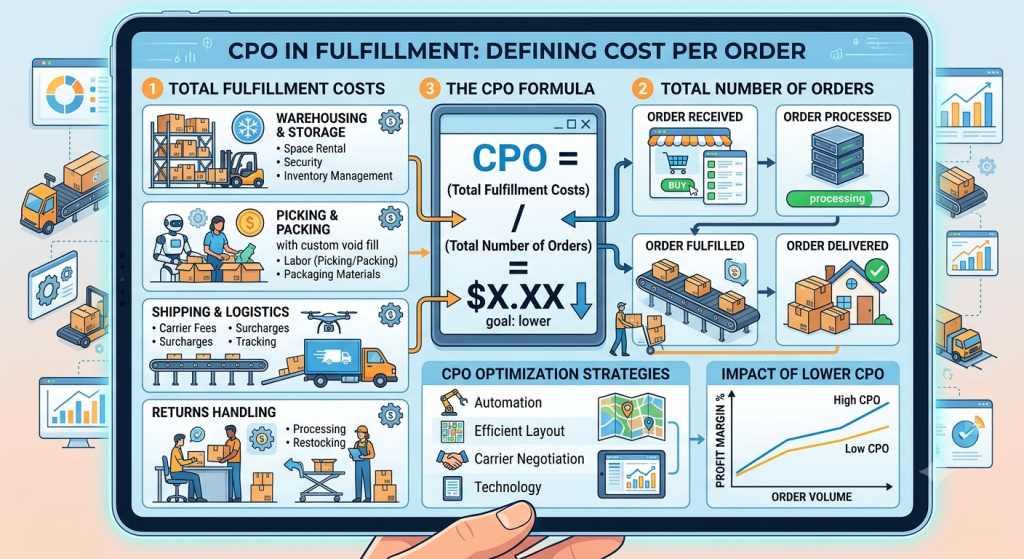
The goal isn’t just to save on storage. It’s to reduce total cost per order while maintaining accuracy and speed.
Which Approach Is Right for You?
Choosing the right bin strategy depends on your business model:
- High-volume, low SKU count (e.g., DTC brands with bestsellers):
→ Single SKU bins are often the best fit. - Low-volume, high SKU count (e.g., parts distributors, accessories):
→ Multiple SKU bins maximize space efficiency. - Growing eCommerce brands with mixed velocity SKUs:
→ A hybrid model offers the best balance.
Choosing What Works for Your Operation
There isn’t a universal answer when it comes to bin storage. A business shipping a small number of high-volume products will naturally benefit from single SKU storage, while a brand with hundreds of low-volume items may lean toward shared bins.
For most growing eCommerce companies and 3PL operations, the hybrid model tends to offer the best balance. It allows you to stay efficient without sacrificing accuracy, and it adapts as your inventory evolves.
Final Thoughts
There’s no one-size-fits-all solution in warehousing. The most efficient operations continuously evaluate SKU velocity, order patterns, and storage constraints to refine their bin strategy.
For many modern 3PLs and eCommerce businesses, a hybrid SKU storage model delivers the flexibility and efficiency needed to scale without sacrificing accuracy.